
What Is Khorasan Wheat?


Among the many grains available to bakers today, few generate as much curiosity as khorasan wheat.
Its kernels are noticeably larger than modern wheat. Its flavor is rich and distinctive. And despite becoming increasingly popular among artisan bakers, many consumers have never heard of it.
At Manna Mill Bread Co., khorasan is one of the foundational grains in our Signature Blend.
We don't use it because it's trendy. We use it because it contributes something truly special to the flavor and character of our bread.
To understand why, it helps to begin with the grain itself.
The Origins of Khorasan Wheat
Khorasan wheat is an ancient grain variety belonging to the wheat family. The grain takes its name from a historical region that once encompassed parts of modern-day Iran, Afghanistan, and Central Asia.
Like many ancient grains, khorasan has remained relatively unchanged compared to modern wheat varieties that have undergone extensive breeding and selection over the past century.
Today, khorasan is grown in limited quantities around the world and is especially valued by artisan bakers for its unique baking qualities and flavor.
What Does Khorasan Wheat Taste Like?
Flavor is the primary reason many bakers fall in love with khorasan.
While modern wheat often provides a neutral foundation for bread, khorasan contributes a character that is immediately recognizable.
Many people describe its flavor as:
Buttery
Nutty
Sweet
Rich
Almost creamy
These qualities become especially noticeable when the grain is freshly milled.
At Manna Mill, one of the reasons we mill our grain fresh is to allow the natural character of grains like khorasan to shine through. When incorporated thoughtfully into a blend, it adds depth and complexity that would be difficult to achieve with modern wheat alone.
Why Bakers Love Working With Khorasan
Khorasan is not simply a flavor ingredient.
It also brings unique characteristics to dough.
Compared to many modern wheat varieties, khorasan often produces dough that feels softer and more extensible. It absorbs water differently and contributes to a finished loaf with a distinct texture and eating experience.
Because of these characteristics, many bakers choose to blend khorasan with other wheat varieties rather than relying on it exclusively.
The goal is not to replace modern wheat, but to enhance it.
Why We Include Khorasan in Our Signature Blend
Every grain in a bread formula should serve a purpose.
At Manna Mill, our Signature Blend combines:
Hard White Wheat
Hard Red Wheat
Khorasan Wheat
Each grain contributes something different.
Hard white wheat provides sweetness and balance.
Hard red wheat contributes depth and structure.
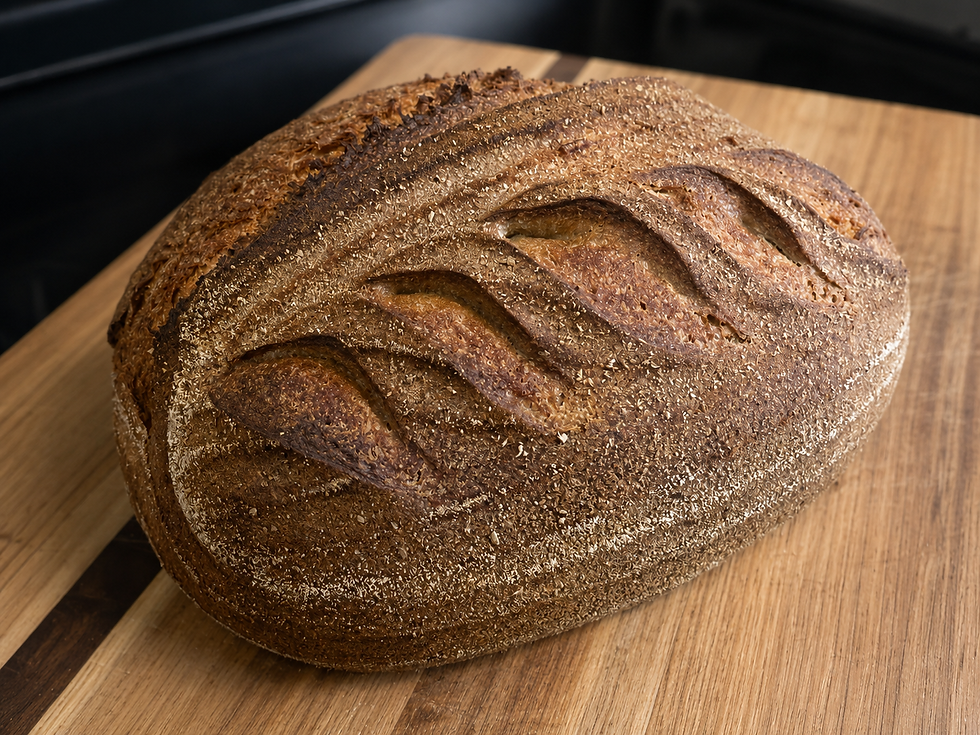
Khorasan brings richness, complexity, and a flavor profile that helps distinguish our bread from conventional loaves.
When people tell us our bread tastes different, khorasan is often part of the reason why.
It doesn't overpower the loaf. Instead, it creates a subtle layer of flavor that makes the bread more memorable.
Is Khorasan Wheat Better Than Modern Wheat?
Not necessarily.
Modern wheat varieties are excellent grains and remain the foundation of bread production throughout the world.
The better question is whether khorasan offers something different.
The answer is yes.
Every grain has its own strengths, weaknesses, and personality. Khorasan simply provides a flavor profile and baking experience that many artisan bakers find compelling.
For us, it represents one more tool that allows us to create bread with greater complexity and character.
Khorasan and Fresh Milling
One of the challenges of discussing grain is that people often focus exclusively on the variety while overlooking how the grain is processed.
The reality is that both matter.
A remarkable grain cannot reach its full potential if its flavor is lost before it reaches the baker.
That's one reason we pair ancient grains with fresh milling.
Fresh milling allows us to begin with whole grain and preserve more of the grain's natural character as it moves from kernel to loaf.
When combined with a grain as flavorful as khorasan, the results can be extraordinary.
An Ancient Grain Worth Discovering
Ancient grains are often discussed in broad terms, but each grain has its own story.
Khorasan stands out because it offers something that many modern wheat varieties do not: a rich, distinctive flavor that remains unmistakably wheat while introducing layers of sweetness and complexity.
For artisan bakers, that combination is difficult to ignore.
For bread lovers, it creates an opportunity to experience wheat in a different way.
And for us, it is one of the reasons our bread begins not with flour, but with carefully selected grain.
If you'd like to learn more about the grains we use, explore our related articles:
Because great bread begins with understanding the grain.

Comments